

Kind, dependable care at home for families facing growing needs and difficult choices.
Live-In Care in Crowborough

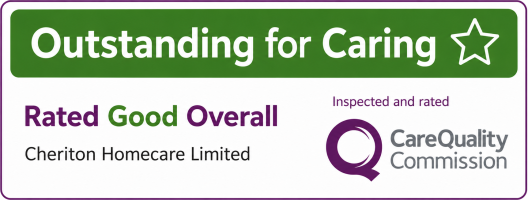

“People were truly respected and valued as individuals, and empowered as partners in their care.” — Care Quality Commission (CQC)


Care built around a town of hills, lanes and long driveways
Arranging live-in care in Crowborough comes with conditions you won’t meet on the coast. The town sits high, and the lanes towards Rotherfield hold their frost long after Lewes has thawed.
Cheriton Homecare has spent close to thirty years in care at home, growing out from live-in care in Brighton to the villages inland.
One carer who stays, and a manager who can picture the address being discussed. We cover the Weald, from Jarvis Brook across to Uckfield.
What our clients and their families say
What your live-in carer can take on
No two placements look alike. Some households need a steady hand for a couple of hours of real work a day and company for the rest; others need a great deal more. A carer’s daily duties are reviewed as things change.
Personal care
Help with washing, dressing, continence and moving safely about the house, given at your relative’s own pace. A live-in carer has the time to do it properly.
Companionship
Company through the ordinary hours, from breakfast conversation to a hand with the crossword. Your carer also keeps the outings going, from the coffee morning to lunch with a friend.
Medication reminders
Prompting and logging what has been taken, so prescriptions stay on schedule. Your carer speaks to the GP practice and the pharmacy whenever a dose changes.
Alzheimer’s and dementia care
Memory loss is easier to live with when nothing else shifts: same house, same chair, same carer. Ours hold dementia training and are matched to the person, not the diagnosis.
Palliative care
Where someone wishes to stay at home to the end, a live-in carer makes that possible. Support runs alongside the community nursing team and increases as needs change.
Household chores and assistance
Cooking, laundry and keeping the house running as it always has. Out in the lanes that covers the weekly shop and the appointment runs that get hard once driving stops.
The case for a Sussex team over a national call centre
Most live-in care around here is booked through national agencies that pick a name off a database and run the placement from a head office. We work the other way round.
Someone sees the house before anything is agreed, you meet the carer first, and the manager on your case has a name and a number. Richard Barnett, our Registered Manager, still does assessments himself.
- Regulated by the Care Quality Commission, with our rating and inspection reports published in full
- Enhanced DBS checks on every carer, plus training that continues for as long as they work with us
- Nobody arrives as a stranger. You read a written profile and speak to the carer before they move in
- A Weald address is not a town address. A house beyond Eridge needs a carer who drives and a plan for the shopping. A bungalow near the high street does not
- Your carer works around the other professionals. Appointments, prescription changes and visits from community nurses are coordinated rather than left to the family to chase
- The care plan follows the real day, not a template, and changes when health does
- Cover is arranged in advance. Digital notes keep relatives informed, a care manager reviews regularly, and holiday cover comes from someone already introduced


The things a residential placement quietly takes away
Whether home is a bungalow off the high street, a cottage towards Mayfield, or a house on the forest side, staying put holds on to a great deal that a move quietly costs. It is the same calculation families weigh up over towards East Grinstead and everywhere else we work.
- Nothing has to be learned again. No new corridors, no unfamiliar bathroom, no strange noises at two in the morning.
- One carer rather than a changing shift pattern. Someone who already knows how he takes his tea and when she wants the radio off.
- The routine survives. The cat, the greenhouse, the Thursday phone call to an old friend.
- Relatives come round when they like. No visiting slots, no signing in, no being asked to leave at eight.
- The same surgery, the same faces. A care home is wherever the vacancy happens to be, which is rarely near the rest of the family.
- The sums surprise people. Live-in care can work out as much as 30% below a residential place, and the gap widens for couples. Weigh the wider advantages before deciding.
Working out which kind of care you actually need
People use live-in care and 24-hour care as though they mean the same thing. They don’t. What live-in care actually covers is one carer who lives in the home, taking agreed breaks through the day and, overnight, either sleeping in their own room or staying awake as need dictates. Where support cannot pause at any hour, that becomes two carers in rotation.
Visiting care is a different model again. A carer comes for a set period, handles specific tasks and leaves, which suits someone still largely managing alone.

Don't wait for the next fall. Get the best care
From the first phone call to the first morning
After a fall or a discharge letter, we can usually have someone in place within days. Where there is no deadline, nothing gets rushed.
Ring, message, or book a callback. We ask what has been happening, answer what we can, and tell you honestly whether live-in care is the right answer.
Richard Barnett or Nastasha, our Field Care Supervisor, comes out in person. Alongside the health picture they note the practical things: where a carer parks, how the stairs work, how far the nearest shop and pharmacy are.
We send written profiles and you ask whatever you want before deciding. For anywhere out in the lanes, we only shortlist carers who drive.
Your carer arrives on the agreed day. Daisy, our Care Coordinator, checks in through those first few days while the household finds its rhythm.
A case manager reviews how the placement is going, and senior management review the case managers. That second layer is what most agencies skip.

Weekly rates, set out plainly
Live-in care is billed by the week. One carer, living in, supporting one household, with no hourly extras.
- From £1,190 a week for one person
- From £1,476 a week where a couple share the home
Live-in care carries no travel or mileage charges, so a house past Eridge costs what a bungalow on the high street costs. Where your own figure lands depends on two things only.
- How much support the day needs. Help with washing, dressing and meals sits at the lower end. Hoisting, complex conditions or two people in the house move it up
- How the nights are covered. Most households need a sleeping night, where your carer is in their room and gets up if called. Where someone is up and wandering, common with dementia, a waking night puts the carer on duty until morning at a higher weekly rate
Paying for it: The routes worth checking
Most families here self-fund, but check before you assume. While your relative lives in the house, its value stays out of the means test for care at home, which is not how a residential place is assessed.
- NHS Continuing Healthcare. We are experienced in supporting NHS Continuing Healthcare (CHC) funded care packages, which can cover the full cost where clinical need is high.
- Local authority support. Your assessment goes through East Sussex County Council, and savings above the threshold usually mean funding your own care
- Direct Payments. Where the council does contribute, taking it this way keeps the choice of agency with you
- Attendance Allowance. Not means-tested, and the one families most often leave unclaimed. It won’t cover a live-in rate alone, but it helps

Live-in care support in Crowborough and nearby areas
We proudly support older adults in the following communities with heartfelt live-in care:
Questions families in Crowborough often ask before taking the next step
Does a live-in carer need their own bedroom?
Yes. A private room they can retreat to, with space for their belongings, is essential. A second bathroom isn’t required, though households that have one tend to find the arrangement easier on both sides.
What happens when the weather closes the lanes?
This is the strongest argument for live-in care up here. Your carer is already in the house, so ice on the hill or a blocked lane changes nothing about that morning.
Do you cover the villages as well as Crowborough itself?
Both. We place carers through Jarvis Brook, Rotherfield, Eridge and Mayfield, and further out towards Tunbridge Wells and Hailsham.
Will my carer be able to drive me to appointments?
Yes, provided they hold a full licence and your policy covers them. Out here that usually matters more than families expect, since most appointments and the bigger shops mean a drive.
Can we book live-in care for a short period only?
Yes. Short placements are common after a hospital stay, as respite while a family carer takes a break, or as a trial before anyone commits to something longer.
Ring us even if you can't yet name what you need
Hardly anyone rings with the answer worked out. Usually something has happened: a fall, a diagnosis, a parent who has been coping badly for longer than anyone realised.
Tell us the situation and we will give you a straight view of it. If what you describe points somewhere other than live-in care, we will say so and help you find the right kind of care instead. Nobody here reads from a script.
Cheriton Homecare give me peace of mind and I know my mum’s needs are met completely. My mum has developed a real connection and even love of her main carer who she has come to trust and rely upon. They bring a security to my mum and become not just carers but also a social network.
Shirley S (Daughter of Client)
Cheriton Homecare helped Mother stay in her own home and keep her independence. She could be difficult as her dementia progressed but nothing was too much trouble for Cheriton, her carers were kind and compassionate. She loved seeing the manager and another member of staff who always made a great fuss of her.
Lynda S (Daughter of Client)
Everyone at Cheriton Homecare exudes calm, confident professionalism with compassion and patience. I am so grateful for their support in providing care for my mother-in-law and being able to respond to a desperate situation so quickly.
H R (Daughter-in-law of Client)
Cheriton Homecare are very, very good. They are absolutely wonderful.
A C (Client)
The two carers (a main one and a holiday relief carer) have fitted in well, seen what needs to be done and quietly got on with it in a cheerful and calm manner. They are looking after both my parents. Having the Cheriton carers there gives the family peace of mind knowing Mum and Dad are being looked after well while allowing them to stay in their own home.
Jan C (Daughter of Client)